Skip to content
No results
  • Home
  • Articles
  • About
  • Contact
Create Playing Cards logo
  • Home
  • Articles
  • About
  • Contact
Create Playing Cards logo
  • Card Sizes & Formats

What Card Size Works Best When Players Hold 10 or More Cards?
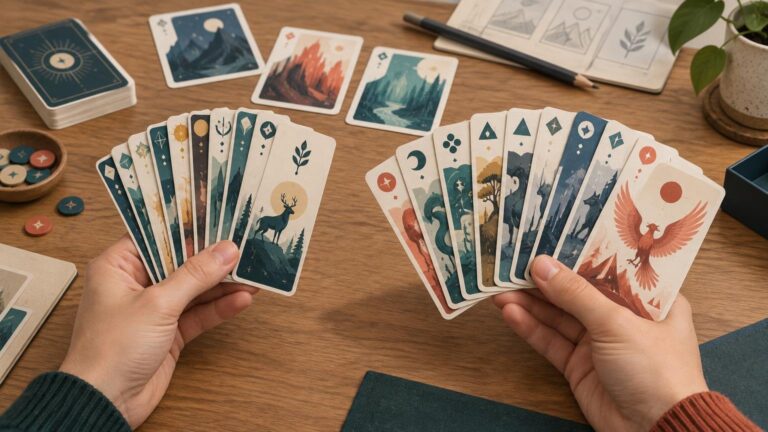
Two hands hold wide fans of illustrated fantasy-style cards over a wooden tabletop, with a stacked deck, game tokens, sketchbook, pencil, and plant nearby.

Bridge-size cards are a strong starting point when players routinely hold 10 or more cards, but physical testing should decide whether the narrower layout leaves enough room for readable information.
  • Ellie
  • September 29, 2026
  • Game Prototyping

How to Prototype Expansion Cards Without Reprinting the Whole Game

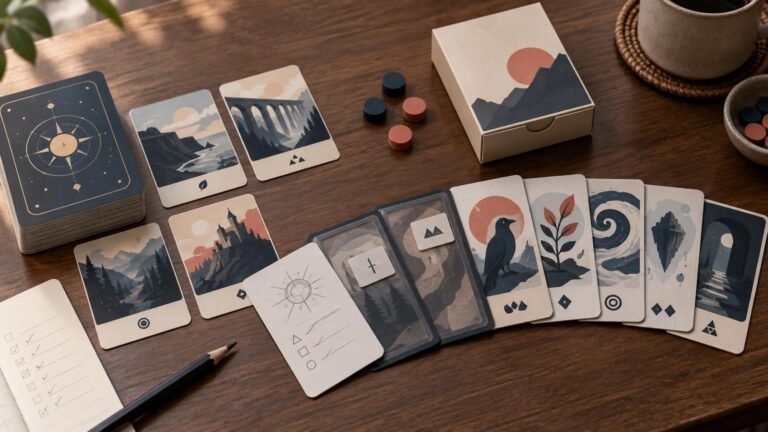
Editorial tabletop scene with illustrated prototype cards, a large deck, loose wooden counters, a small landscape-art box, sketch sheets, and a pencil arranged on a wooden table.

Use the finished base game as a stable control, print only the expansion components needed for the next test, and increase prototype fidelity when physical compatibility starts affecting the result.

  • Ellie
  • September 26, 2026
  • Game Prototyping

How to Test Card Layout Readability Before Printing 100 Copies

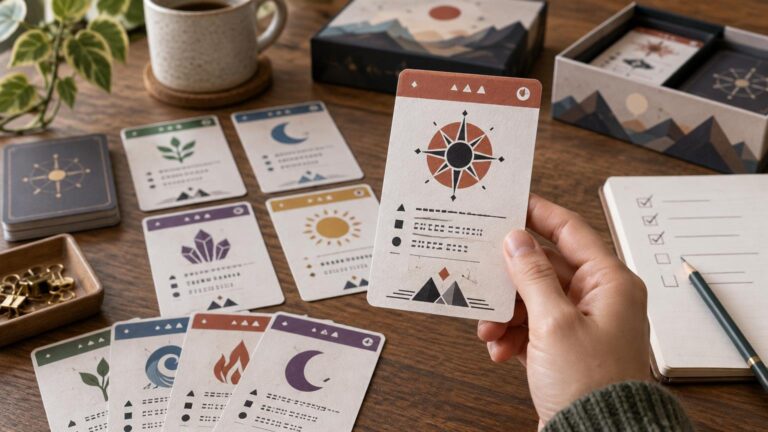
A hand holds an illustrated prototype card above a wooden table with several color-coded cards, stacked decks, open card boxes, a checklist notebook, pencil, coffee mug, and paper clips.

A practical workflow for testing card hierarchy, text, icons, hand visibility, physical handling, and print constraints before committing to a larger run.

  • Ellie
  • September 24, 2026
  • Specialty Card Projects

Photo Playing Cards: How to Prepare Images for a Full Custom Deck

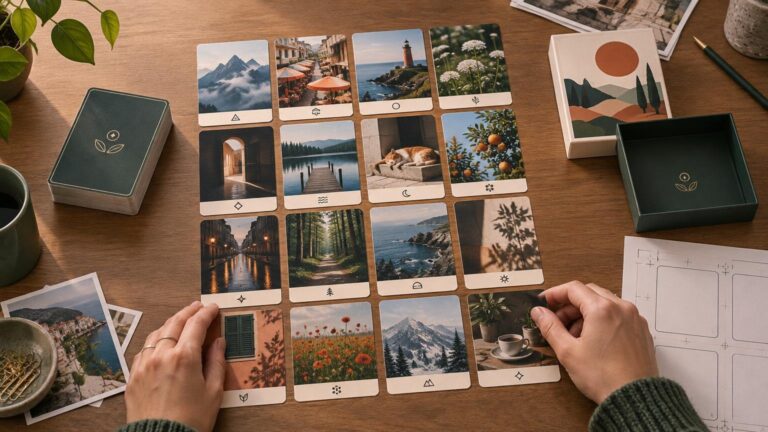
Overhead view of hands arranging a grid of photo-illustrated cards on a wooden table beside a stacked deck, open dark-green card box, printed card layout sheet, photographs, pencil, and cups.

Turn a folder of photographs into a coherent, playable custom deck by planning every card, cropping against the printer’s template, checking resolution, and proofing the complete physical object.

  • Ellie
  • September 17, 2026
  • Deck Design & Files

Vector vs Raster Artwork for Card Faces, Icons, and Text

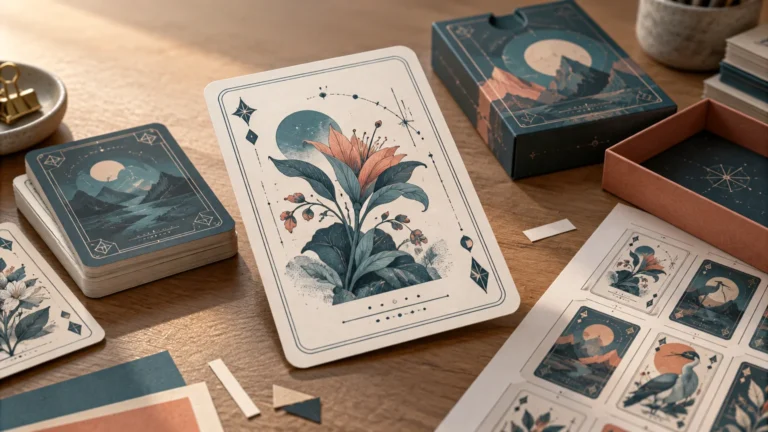
Warm tabletop scene showing an illustrated botanical card standing beside a stacked deck, a dark teal tuck box, an open peach box, card-stock swatches, and a sheet of small card-layout previews.

Use vector artwork for text, icons, borders, and linework; use properly resolved raster artwork for paintings, photos, scans, and textures. This guide explains how to combine both in a production-ready card file.

  • Ellie
  • September 15, 2026
  • Card Sizes & Formats

Portrait vs Landscape Custom Cards: How Orientation Changes the Layout

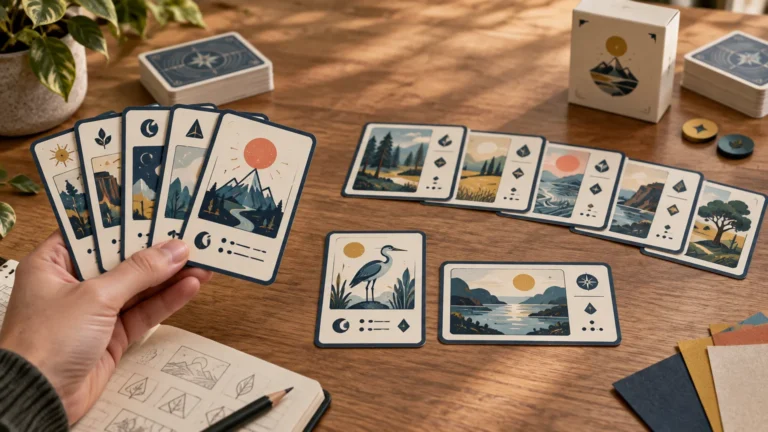
Designer holding a fan of illustrated portrait cards beside a tabletop spread of portrait and landscape cards, card stacks, a small deck box, color swatches, and sketchbook notes.

Portrait and landscape cards can have the same area but behave very differently in a hand, on a table, and inside a layout. Use this guide to choose an orientation before finalizing artwork and packaging.

  • Ellie
  • September 12, 2026
  • Specialty Card Projects

Custom Recipe Card Decks: How to Make Them Easy to Read and Handle

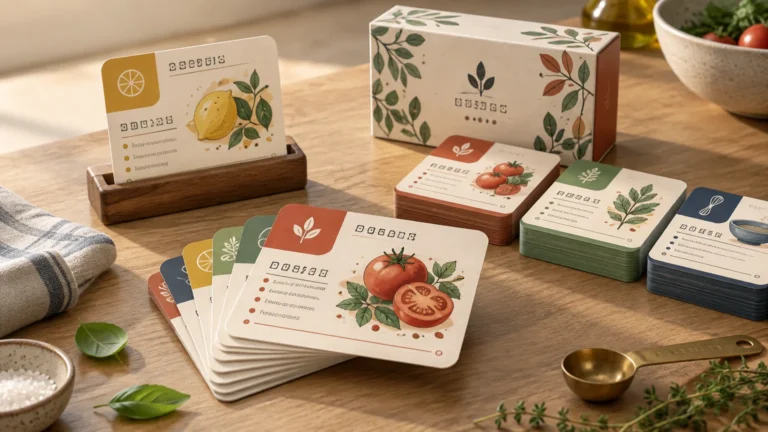
Warm tabletop scene of a custom recipe card deck with rounded illustrated cards in wooden holders and neat stacks, beside a floral tuck box, tomatoes, herbs, bowls, and a measuring spoon.

A practical guide to designing a recipe card deck that is readable, easy to sort, comfortable to handle, and properly prepared for printing and packaging.

  • Ellie
  • September 10, 2026
  • My Blog

How to Build a Card Game Prototype Before You Pay for a Full Print Run

TLDR The first version of your card game should probably look bad. That is a good thing. A card game prototype exists to answer questions. Is the game fun? Does the turn structure make sense? Are players making interesting decisions?…

  • Carole Williams
  • September 2, 2026
  • MTG Proxies

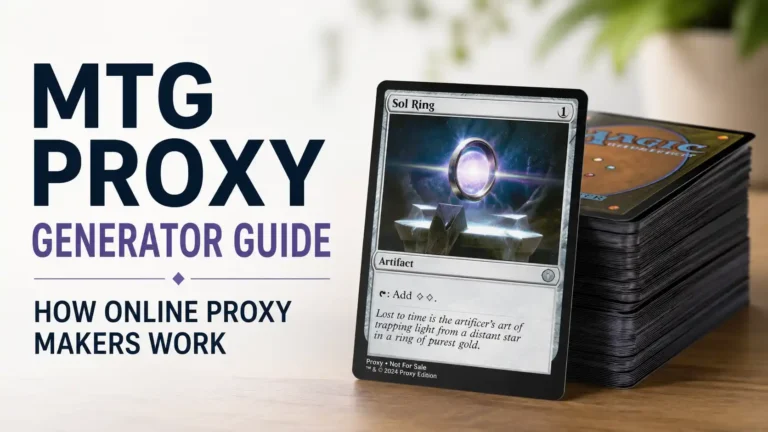
MTG Proxy Generator Guide: How Online Proxy Makers Work

An MTG proxy generator is a tool that helps players turn card names, decklists, custom designs, or cube lists into printable Magic: The Gathering proxy cards. Sometimes that means a simple PDF you print at home. Sometimes it means a…

  • Carole Williams
  • July 6, 2026
  • My Blog

Custom MTG Proxy Cards for Commander: How to Keep Them Fun and Table-Friendly

Custom MTG proxy cards for Commander can make casual deckbuilding more creative, more affordable, and more personal. Commander is already the format where people build squirrel armies, dragon tax plans, haunted artifact engines, and decks based on jokes that somehow…

  • Carole Williams
  • June 30, 2026
  • My Blog

Custom Tarot Card Deck Printing: What Artists Should Plan Before They Print

Custom tarot card deck printing is exciting because a tarot deck is not just a stack of cards. It is art, symbolism, packaging, rhythm, and touch all wrapped into one object. People handle tarot cards slowly. They look at the…

  • Carole Williams
  • June 29, 2026
  • My Blog

How to Make a Card Game Prototype Without Making Yourself Miserable

How to make a card game prototype is one of those questions that sounds simple until you are staring at 143 cards, twelve half-written rules, and a spreadsheet that has started to look personally offended. A good prototype does not…

  • Carole Williams
  • June 29, 2026
Prev
1 2 3 4
Next
Create Playing Cards

Contact

  • contact@createplayingcards.com

About This Site

Practical guidance for designers, artists, educators, and publishers choosing card sizes, print files, stocks, finishes, prototypes, and packaging.

Topics

  • Card Sizes & Formats
  • Card Stock & Finishes
  • Deck Design & Files
  • Game Prototyping
  • Boxes & Packaging
  • Specialty Card Projects
© 2026 Create Playing Cards

Information

  • Privacy Policy
  • About Us
  • Contact
  • Editorial Policy
  • Trust & Transparency
  • All Articles