Skip to content
No results
  • Home
  • Articles
  • About
  • Contact
Create Playing Cards logo
  • Home
  • Articles
  • About
  • Contact
Create Playing Cards logo
  • Boxes & Packaging

How Card Thickness Changes the Box Depth You Need
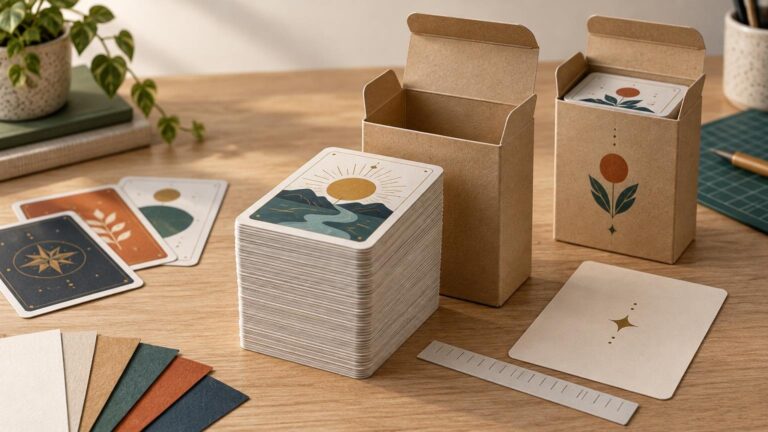
Stack of thick rounded-corner illustrated cards beside two open kraft tuck boxes, loose sample cards, paper-stock swatches, and a ruler on a wooden worktable.

A tuck box should be sized from the measured thickness of the complete packed deck—not card count or stock weight alone. Use this workflow to estimate the required internal depth and verify it with a physical prototype.
  • Ellie
  • October 29, 2026
  • Specialty Card Projects

Customer appreciation gifts with a logo — Custom Cards and Branded Project Ideas

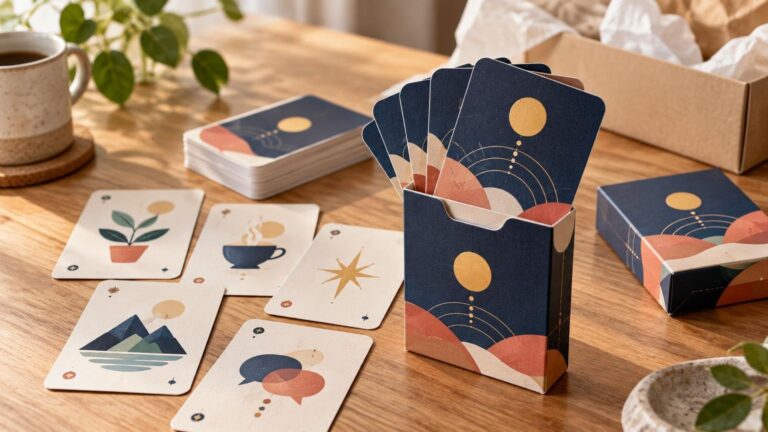
Illustrated custom card deck with navy, coral, and gold geometric artwork, displayed in an open tuck box on a wooden table beside loose cards, a closed box, coffee, and plants.

A custom card deck can turn a routine logo gift into something playable, useful or collectible. Explore practical project ideas, branding choices and production steps.

  • Ellie
  • October 28, 2026
  • Specialty Card Projects

Tarot Size vs Poker Size Cards for Custom Illustrated Decks

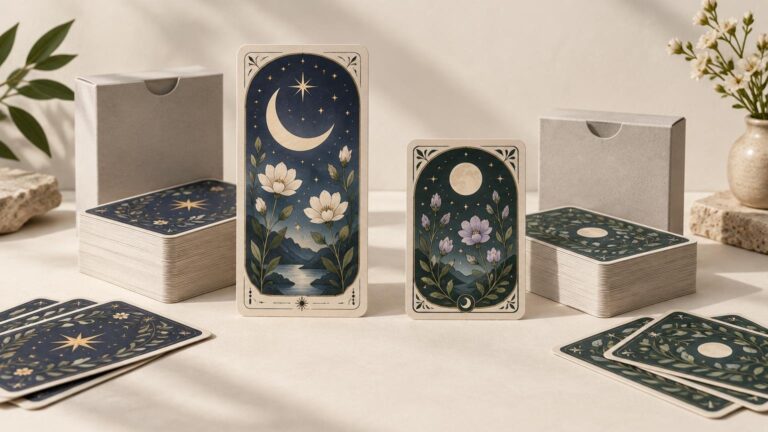
Editorial tabletop scene comparing a tall moon-and-flower illustrated card with a shorter card, surrounded by two stacks of cards, plain gray tuck boxes, and loose face-down cards with dark botanical backs.

Tarot cards provide a taller canvas for expressive artwork and supporting text, while poker cards are more compact in the hand, on the table and in a package. Here is how to choose the right format for an illustrated deck.

  • Ellie
  • October 25, 2026
  • Card Stock & Finishes

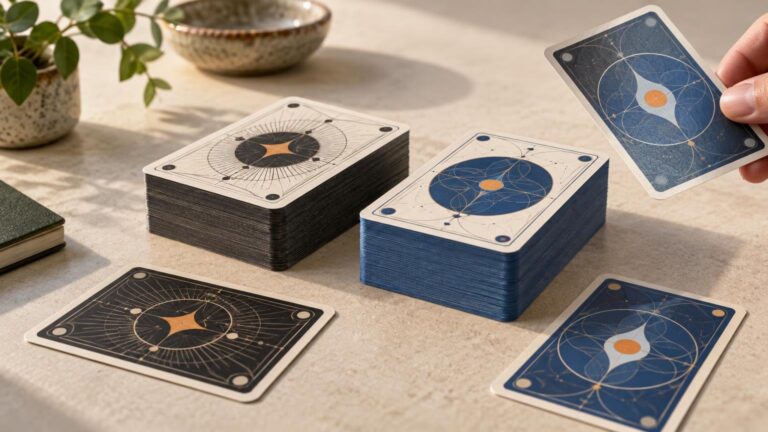
Black-Core vs Blue-Core Playing Card Stock

Two stacks of rounded-corner cards with dark black and blue edges sit on a sunlit tabletop beside matching loose cards, while a hand holds up a blue-backed card with an abstract geometric design.

Black core and blue core describe an internal opacity layer, not the complete quality or handling of a playing card. Compare finished samples for show-through, stiffness, finish, durability and deck thickness before choosing.

  • Ellie
  • October 22, 2026
  • Game Prototyping

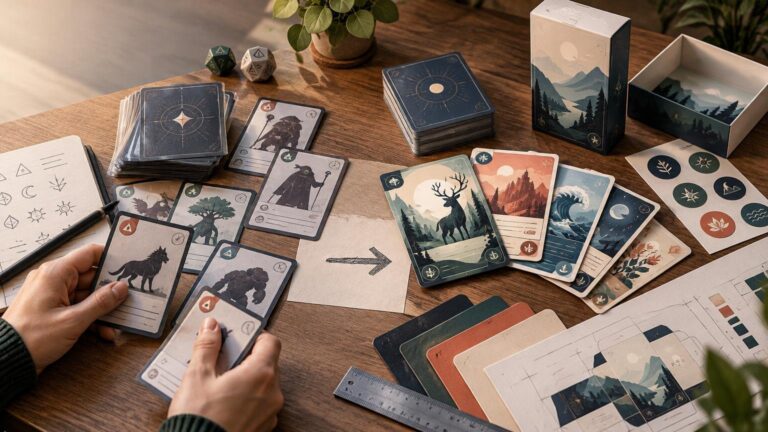
PrintMTG vs MakePlayingCards: Why the MTG Workflow Wins

Hands arrange illustrated fantasy-style cards on a wooden table with stacked decks, dice, card backs, symbol stickers, paper templates, a ruler, and two landscape-illustrated card boxes.

PrintMTG offers the more direct workflow for MTG playtest decks and custom Magic-style cards, while MakePlayingCards is better suited to original games and elaborate deck production.

  • Ellie
  • October 21, 2026
  • Boxes & Packaging

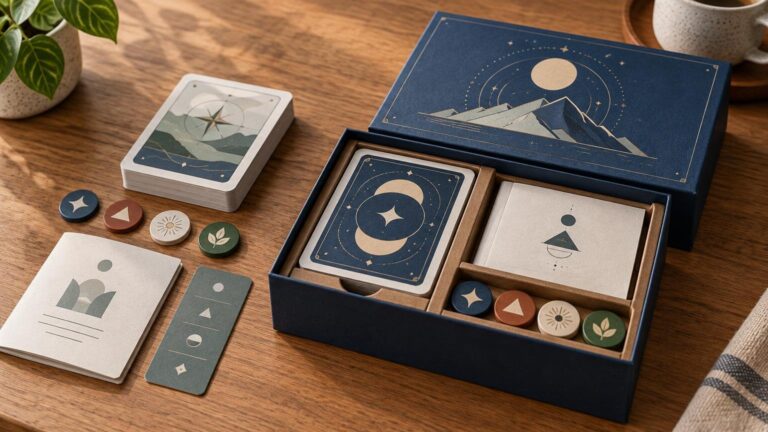
How to Plan Packaging for a Deck With Extra Rules or Tokens

Open navy two-piece card-game box on a wooden table, holding a deck, a small booklet, and four round tokens, with extra cards and a rules sheet arranged beside it.

Plan the box around the complete packed product—not the card count alone. This workflow covers deck thickness, rules, tokens, inserts, presentation, prototypes, and shipping.

  • Ellie
  • October 18, 2026
  • Card Stock & Finishes

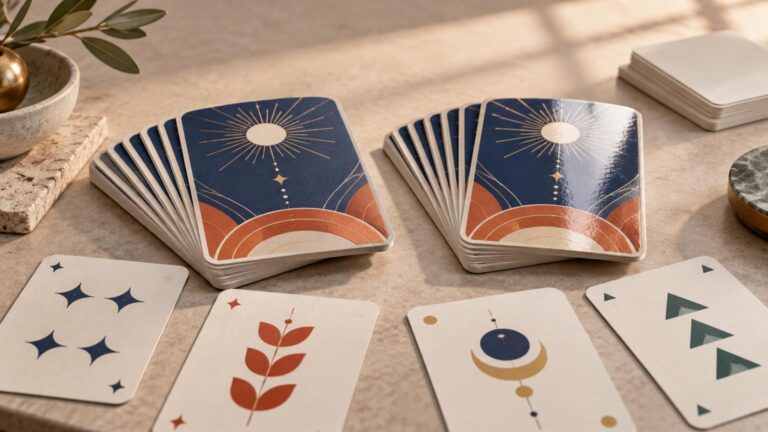
Matte vs Gloss Finish for Custom Playing Cards

Two fanned decks of rounded-corner custom cards on a warm tabletop, showing a matte dark-blue celestial card back on the left and a glossy reflective version on the right, with abstract illustrated face cards in front.

Matte and gloss primarily change how a card reflects light. Learn how to choose a finish while separately evaluating stock, opacity, stiffness, texture and handling.

  • Ellie
  • October 15, 2026
  • Boxes & Packaging

Window Box vs Closed Tuck Box for Retail Card Decks

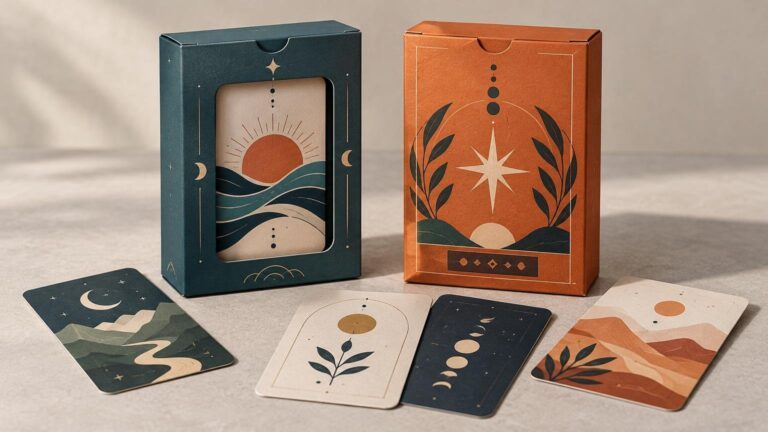
Two upright card-deck tuck boxes on a neutral tabletop: a dark teal box with a large window revealing a sun-and-waves card, and an orange closed box with a star, leaves, and landscape illustration. Four matching rounded-corner illustrated cards are spread in front.

Choose a windowed tuck box when seeing an actual card helps sell the deck. Choose a closed tuck box when branding and retail information need the full printed surface.

  • Ellie
  • October 14, 2026
  • Card Sizes & Formats

Mini European vs Poker Size Cards for Tabletop Games

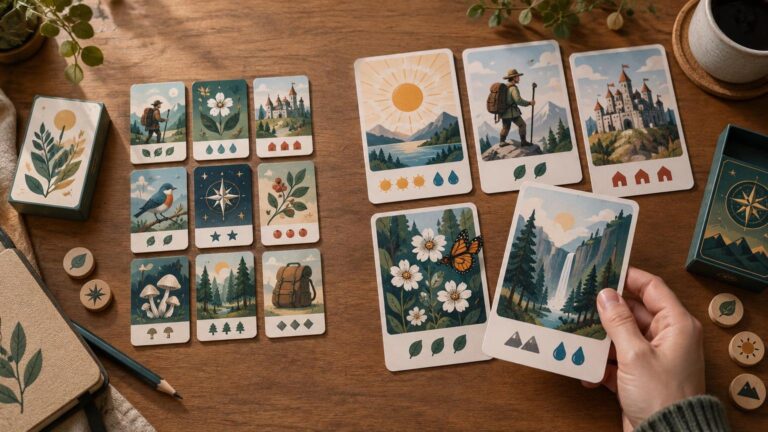
Overhead view of a wooden tabletop comparing a grid of small illustrated game cards with several larger cards, alongside matching deck boxes, round tokens, a notebook, pencil, coffee cup, and a hand holding two large cards.

Mini European cards save substantial table space, while Poker-size cards provide more room for text, artwork, and information hierarchy. Compare both formats before building your next prototype.

  • Ellie
  • October 11, 2026
  • Game Prototyping

Kickstarter Card Game Sample Deck: What Should It Prove?

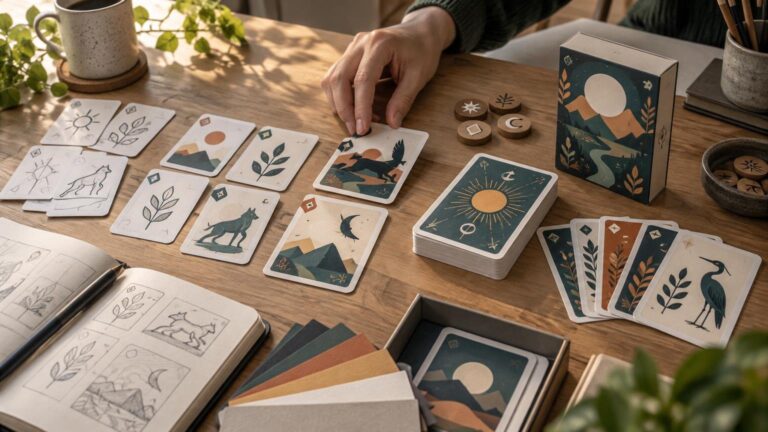
Designer arranging an illustrated fictional card game prototype on a wooden table, with card stacks, wooden tokens, a tuck box, paper swatches, and a sketchbook.

A sample deck should answer a defined question, not merely look finished. Match prototype fidelity to gameplay, usability, campaign, and production decisions.

  • Ellie
  • October 8, 2026
  • Boxes & Packaging

Where to Put a Barcode on a Retail Playing Card Box

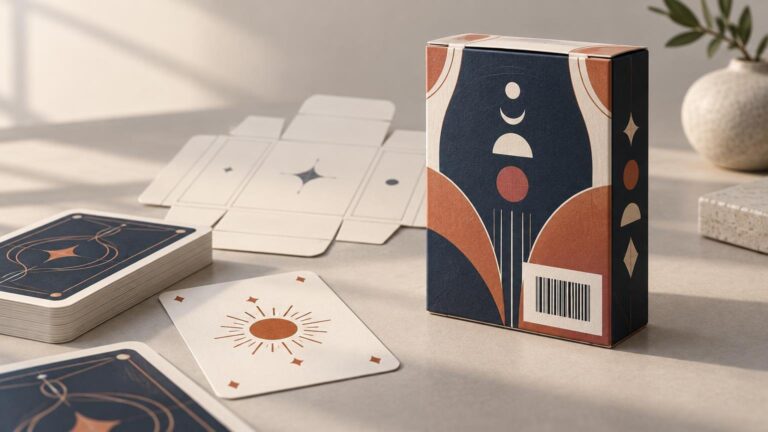
A navy, rust, and cream playing-card box stands on a tabletop beside a stacked deck, loose illustrated cards, and an unfolded box template; a barcode is printed near the lower-right corner of the box’s visible panel.

Put a retail UPC or EAN barcode on the lower-right area of the finished playing-card box’s back panel whenever the structure allows. This guide explains how to protect that scan area while choosing the box, finish, and packed contents.

  • Ellie
  • October 6, 2026
  • Boxes & Packaging

How to Package Custom Card Decks for Shipping Without Crushed Corners

Overhead editorial image of illustrated custom card decks, a white two-piece card box, corner protectors, a paper sleeve, tissue paper, and open corrugated shipping mailers arranged on a beige tabletop.

Protect custom card decks in transit with an inside-out packaging system that accounts for card count, stock thickness, inserts, finishes, retail presentation, and shipment quantity.

  • Ellie
  • October 3, 2026
1 2 3 4
Next
Create Playing Cards

Contact

  • contact@createplayingcards.com

About This Site

Practical guidance for designers, artists, educators, and publishers choosing card sizes, print files, stocks, finishes, prototypes, and packaging.

Topics

  • Card Sizes & Formats
  • Card Stock & Finishes
  • Deck Design & Files
  • Game Prototyping
  • Boxes & Packaging
  • Specialty Card Projects
© 2026 Create Playing Cards

Information

  • Privacy Policy
  • About Us
  • Contact
  • Editorial Policy
  • Trust & Transparency
  • All Articles