
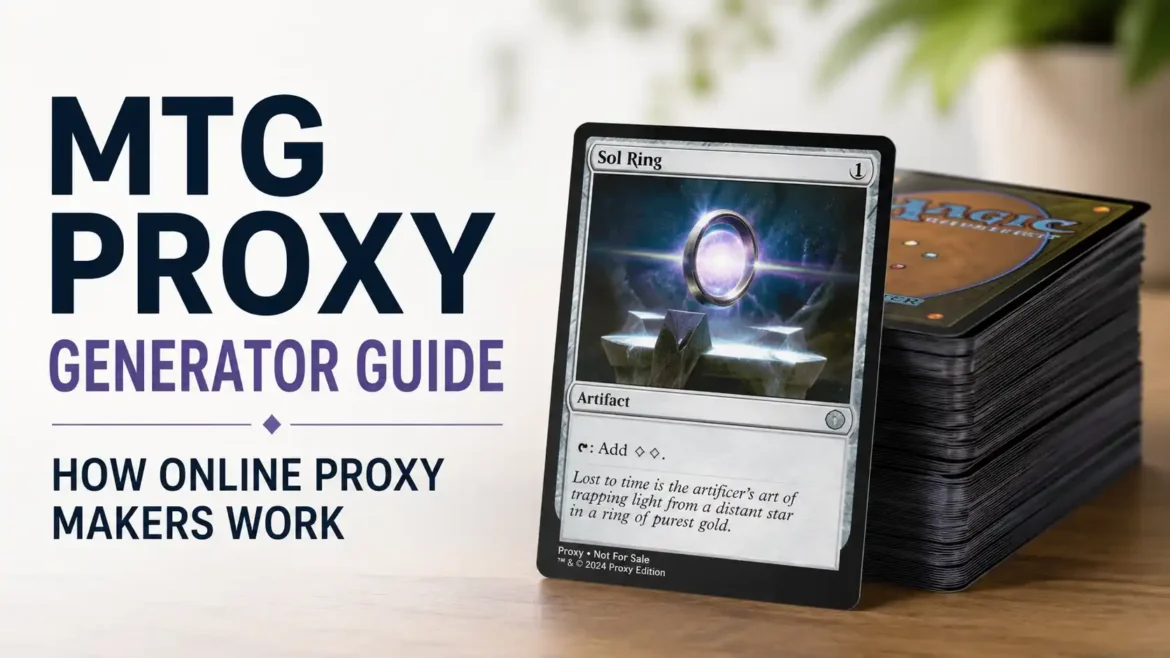
An MTG proxy generator is a tool that helps players turn card names, decklists, custom designs, or cube lists into printable Magic: The Gathering proxy cards. Sometimes that means a simple PDF you print at home. Sometimes it means a full print-on-demand workflow where you paste in a decklist, pick versions, approve the order, and get a sleeve-ready stack of cards in the mail.
The basic idea is simple: proxies let players test decks, protect expensive cards, build cubes, or play casual formats without buying every original card first. The details are where things get messy. Image quality, card sizing, bleed, cardstock, finish, cutting, card backs, and responsible use all matter.
Also, the boring-but-important note: MTG proxies are for casual play, testing, Commander pods, cube nights, and proxy-friendly events. They are not official tournament-legal Magic cards. Wizards of the Coast has said it does not want to police personal, non-commercial playtest cards, but sanctioned events and deceptive use are a separate issue. A good proxy generator should make that distinction clear instead of pretending rules are just optional flavor text.
What Is an MTG Proxy Generator?
An MTG proxy generator is usually one of three things.
First, it can be a browser-based design tool. You enter card information, upload art, adjust text, choose a frame style, and export the card image or print sheet. Sites like MTG.cards focus on creating and printing custom Magic-style cards for playtesting or collecting, which makes them useful when you are making custom commanders, cube cards, tokens, or joke cards that somehow become permanent members of your playgroup.
Second, it can be a decklist-to-print tool. Instead of designing every card manually, you paste a Commander deck, cube list, or test deck into a form. The tool matches each card name to a card database, lets you pick printings, and creates an order. PrintMTG is a good example of this model because it lets users upload or paste a deck list, choose card versions, and print proxies on playing-card stock.
Third, it can be a more traditional proxy printing store. In that setup, you browse card pages, add proxies to a cart, and order them like any other product. ProxyKing fits that lane because it has a large catalog of individual MTG proxy cards and sets already organized by card type and color.
The best option depends on what you are trying to build. A cube owner has different needs than a Commander player testing ten upgrades. A custom-card designer has different needs than someone who just wants a readable playtest version of a Reserved List card.
Step 1: Decklist Input
Most modern MTG proxy makers start with a card list. That list might come from Moxfield, Archidekt, MTGGoldfish, a text file, or a messy spreadsheet you swear is “basically organized.”
A good generator should understand common list formats, including:
1 Sol Ring
1 Command Tower
1 Cyclonic Rift
1 Rhystic Study
Better tools can also handle set codes, quantities, sideboards, maybeboards, tokens, and custom notes. This matters because decklists are rarely clean forever. Someone always writes “Lightning Bolt x4” instead of “4 Lightning Bolt,” and suddenly the machine has to decide whether it is helping a Magic player or parsing a ransom note.
Decklist import is where a print-focused tool like PrintMTG becomes useful. Its workflow is built around uploading or pasting a full list, selecting versions, and sending the project to print instead of making you rebuild a deck card by card.
Step 2: Card Matching and Version Selection
Once a list is uploaded, the proxy generator has to match each card name to the right Magic card. For simple cards, this is easy. “Swords to Plowshares” is not exactly obscure.
But version selection can get complicated. Many MTG cards have dozens of printings, alternate arts, Secret Lair versions, showcase frames, borderless versions, retro frames, promos, and language variants. A good proxy maker lets you choose the version you want before printing.
This is especially useful for Commander players. You may want the prettiest version of a card, the most readable version, or the one that visually matches the rest of the deck. For cube, readability usually matters more. If eight players are drafting fast, nobody wants to squint at ultra-stylized text boxes all night.
Sites like ProxyMTG lean into the idea that proxy cards are stand-ins for casual play, Commander, Cube, and deck testing. That framing is helpful because it keeps the goal focused on gameplay, not pretending a card is something it is not.
Step 3: Image Generation and Card Rendering
After the card list is matched, the proxy generator needs to create a printable image for each card. This is the rendering stage.
For normal MTG proxies, the tool may pull existing card data and pair it with a card image. For custom proxies, it may create a new render from user-entered fields like:
Card name
Mana cost
Type line
Rules text
Power and toughness
Loyalty
Artist credit
Expansion symbol
Custom art
Frame style
This is where browser-based tools can be fun. You can make custom commanders, joke cards, cube-specific errata cards, or tokens that look cleaner than a sticky note on a basic land.
But this is also where responsible design matters. A proxy should be clear enough to play with, but it should not be created for deception. Proxy-focused printers such as Proxy Foundry make that line explicit, describing their products as proxies for casual play, testing, Commander, cube, and practice builds rather than tournament-legal cards.
Step 4: Layout, Bleed, and Cut Margins
A card image is not automatically print-ready. To print cleanly, the file needs proper layout.
That usually means the generator has to account for:
Card size
Safe zone
Bleed
Corner radius
Cut tolerance
Sheet layout
Back design
Export format
Bleed is the extra artwork that extends beyond the final cut line. Without bleed, tiny cutting shifts can leave white edges. Safe zones do the opposite job: they keep text and important design elements away from the edge so nothing important gets clipped.
For print-at-home proxies, the generator may lay out nine cards on a letter-size or A4 sheet. The user prints the page, cuts the cards, and sleeves them in front of basic lands. This is cheap and works fine for testing, although your paper cutter may become your new least-favorite household object.
For professional printing, the generator or print service needs cleaner production files. PrintMTG has print-focused guides on file formats, cardstock, and print settings, including discussions of PDF, PNG, and JPG workflows for proxy printing.
Step 5: Export or Print-On-Demand
Once the cards are rendered and laid out, the proxy maker usually gives you one of two outputs.
The first option is a downloadable file. This is often a PDF. You print it yourself, cut the cards, and sleeve them. It is the cheapest route, and for early deck testing, it is usually good enough.
The second option is print-on-demand. The site takes the file, prints the cards, cuts them, finishes them, and ships them. This is more expensive than home printing, but it is also much cleaner. You get consistent size, better cardstock, smoother shuffling, and fewer evenings spent trimming rectangles.
For single decks or Commander builds, PrintMTG and ProxyMTG are good examples of online proxy workflows that make sense for players who want a clean result without doing all the file prep themselves. For individual high-demand cards or prebuilt proxy selections, ProxyKing is more like a catalog-based store where you can pick specific proxies directly.
Step 6: Materials and Print Quality
The biggest difference between a quick proxy generator and a good print workflow is material quality.
A home printer can make readable proxies, but it usually cannot recreate the feel of a real playing card. The paper is often too thin, too thick, too glossy, too dull, or just slightly cursed. In sleeves, it may be fine. Unsleeved, it usually feels wrong immediately.
Professional proxy printers focus on things like:
Black-core cardstock
Consistent thickness
Smooth finish
Protective coating
Sharp text
Accurate cutting
Rounded corners
Consistent backs
The goal is not just to make the card look good in a photo. It has to shuffle well, sit evenly in a sleeve, and not mark itself in the deck. If one proxy is thicker, taller, glossier, or more curled than the rest, players can accidentally identify it during play. That is bad, even in casual games.
PrintMTG describes its proxy printing around premium black-core playing-card stock, standard MTG sizing, smooth finish, and sleeve-ready results, which is exactly the kind of material language players should look for when comparing services.
Step 7: Cube-Specific Proxy Generators
Cubes are their own beast. A Commander player may need 10 proxies. A cube owner may need 360, 450, 540, or 720 cards, plus tokens, basics, conspiracies, helper cards, and replacements when somebody spills a drink because apparently sleeves are not force fields.
That is why cube proxy tools and cube printing sites often work differently. They need to handle large lists, archetype balance, duplicates, custom inclusions, and consistent print quality across hundreds of cards.
PrintACube is built specifically around MTG proxy cubes, with ready-to-draft cube products and a flagship 540-card cube model. That makes it a strong fit for people who want the cube experience without building every card file from scratch.
Hundred Dollar Cube is another cube-focused option, built around the idea of making a full 540-card cube accessible at around the $100 mark. It is useful for players who care less about owning every original card and more about getting a cube to the table.
For cube owners who want to compare options before ordering, PrintReviewer has covered MTG proxy cube printing sites and recommends PrintACube for full cube printing while noting that PrintMTG and ProxyMTG are better when you want more list-by-list customization.
Print-at-Home vs Online Proxy Maker
A print-at-home proxy generator is best when you are testing fast. Maybe you want to see if a card belongs in a deck before spending money. Maybe you are trying a new Commander list this weekend. Maybe your pod agreed to test cEDH lists and nobody wants to mortgage a sandwich to buy dual lands.
Print-at-home is best for:
Early playtesting
Temporary deck changes
Budget experiments
Cards you may cut soon
Very casual tables
Online proxy printing is better when you want the cards to last. If you are building a cube, proxying an entire Commander deck, or making a repeatable playtest gauntlet, professional printing saves time and gives you a cleaner table experience.
Online printing is best for:
Commander decks
Long-term playtest decks
Proxy cubes
Battle boxes
Legacy or Vintage testing
Custom cards and tokens
Cards you will shuffle often
There is no single correct answer. The right workflow depends on whether you need cheap, fast, polished, durable, or customizable. Pick two or three. Expecting all five at once is how hobbies turn into spreadsheets.
What Makes a Good MTG Proxy Generator?
A good MTG proxy generator should do more than slap card images into a PDF. The better tools make the whole process less annoying.
Look for:
Easy decklist import
Accurate card matching
Multiple card versions
Readable previews
Clean PDF export
Bleed and safe-zone support
Custom card options
Clear proxy labeling
Print-ready file settings
Simple reorder tools
Transparent pricing
Responsible use policies
If the tool is connected to a print service, also look for real production details. What stock do they use? How long does production take? Are the cards cut consistently? Are they meant to be sleeved? Can you upload custom designs? Can you print tokens? Can you reorder the same deck later?
Sites like Proxy Foundry and ProxyMTG are useful examples because they publish clear proxy-use language and explain that proxies are for casual play and testing, not sanctioned tournament play or deceptive resale.
Where Printiverse Fits
Most MTG proxy work should go through a card-focused service because cards have specific sizing, cutting, and handling requirements. But a broader printer like Printiverse can still be useful around the edges of an MTG proxy project.
For example, if you are building a cube night, tournament, store event, or Commander league, Printiverse makes more sense for supporting materials such as:
Event flyers
Table signs
Rule inserts
Scorecards
Draft guides
Token reference sheets
Deck registration sheets
Prize cards
Posters
The cards themselves should usually come from a proxy-focused tool or printer. The event materials can come from a broader print shop. That division keeps the card workflow specialized while still giving the whole event a more polished feel.
Common Mistakes to Avoid
The most common MTG proxy generator mistake is ignoring readability. Beautiful alt-art cards can be great, but if nobody can read the name, mana cost, or rules text, the card is slowing down the game.
Other mistakes include:
Using low-resolution images
Forgetting bleed
Cutting too close to the border
Mixing card thicknesses in one deck
Printing unsleeved proxies on flimsy paper
Using confusing card backs
Failing to label custom cards clearly
Ordering a full cube before testing the list
Assuming proxies are allowed everywhere
The last point matters. Always ask your playgroup, store, or event organizer before bringing proxies. Many Commander groups are relaxed about them. Some stores allow them for casual nights. Sanctioned events are different. Do not make the judge, store owner, or table have an awkward rules conversation five minutes before round one.
Final Thoughts
An MTG proxy generator is basically a bridge between a deck idea and a playable stack of cards. The simplest versions create printable sheets. Better tools import decklists, match card versions, add bleed, generate print-ready files, and connect directly to professional production.
Use PrintMTG or ProxyMTG when you want a smoother decklist-to-print workflow. Use ProxyKing when you want to browse and order specific proxy cards from a catalog. Use Proxy Foundry or MTG.cards when custom card creation and print support matter. Use PrintACube or Hundred Dollar Cube when the real goal is getting a draftable cube on the table without turning your weekend into a print-shop internship.
The best MTG proxy generator is not always the one with the most features. It is the one that gets you clean, readable, properly sized cards that your group is comfortable playing with. That is the whole point: more games, more testing, more cube drafts, and fewer moments where someone has to say, “Wait, what does this card do?” for the fourth time.