
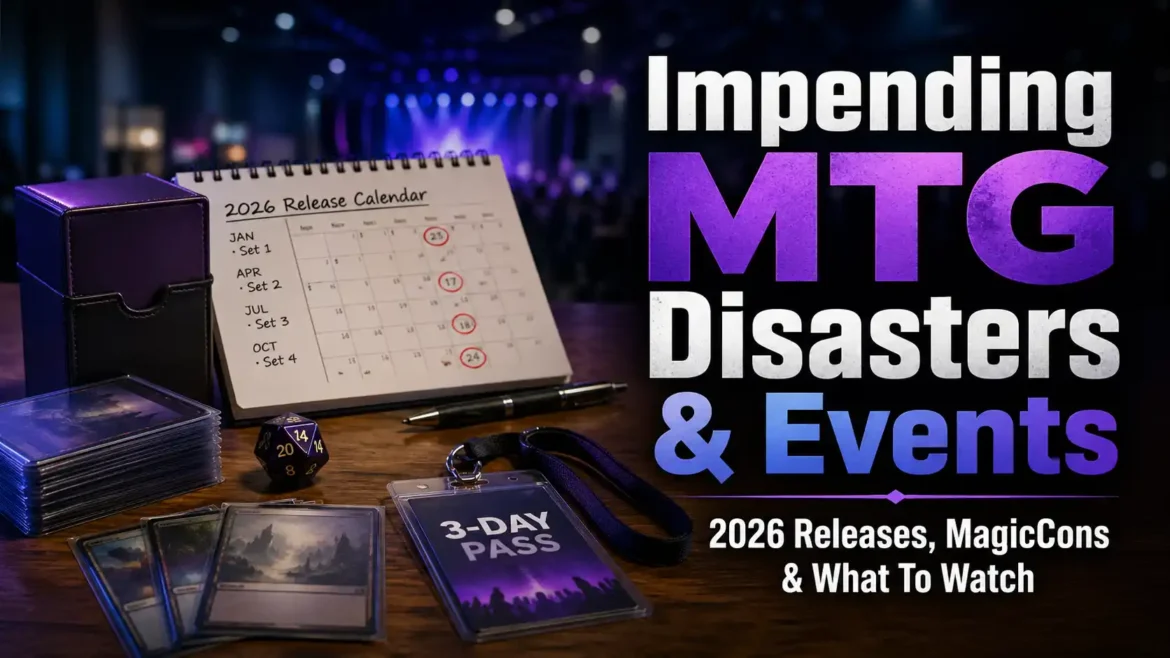
TLDR
Impending MTG disasters and events fall into three buckets: the official 2026 release calendar, big MagicCon and Pro Tour weekends, and the in-story threat building toward Reality Fracture. The real “disaster” for most players is not a literal apocalypse. It is wallet fatigue, spoiler overload, and trying to keep too many decks updated at once.
The best prep is simple: track the sets you actually care about, proxy and playtest before buying expensive cards, and avoid panic-ordering every shiny crossover card the week it gets previewed. For casual testing and Commander nights, MTG proxy printing is the most useful fit here because it lets you test decks without buying every new card immediately.
Intent Sentence
This post helps Magic players understand impending MTG disasters and events by separating official releases, lore-level threats, and player-facing pressure points, so they can plan decks, budgets, and playtesting without getting buried by the 2026 calendar.
Introduction
Magic is having one of those years where the release calendar looks like someone cast Storm on the product schedule. Lorwyn. Strixhaven. TMNT. Marvel. The Hobbit. Reality Fracture. Star Trek. That is a lot of cardboard, a lot of previews, and a lot of “do I need this for Commander?” conversations.
So when players talk about impending MTG disasters and events, they usually mean two things at once. There are the actual official events: set releases, MagicCons, Pro Tours, and the World Championship. Then there are the “disasters” in the casual player sense: too many releases, too many must-read spoilers, too many cards that might matter for your deck, and not enough time to test anything before the next preview season starts.
And then there is Reality Fracture, which is the most literal “something bad is coming” set on the schedule. Wizards has framed it as the payoff to years of subtle story movement, with a villain reveal still being held back. Very normal. Nothing ominous there. Probably fine.
The Big 2026 MTG Release Schedule
As of April 28, 2026, three major 2026 Magic releases have already happened: Lorwyn Eclipsed, Magic: The Gathering | Teenage Mutant Ninja Turtles, and Secrets of Strixhaven. The rest of the year still has several heavy hitters.
Here is the clean version of the schedule:
| Set | Release Date | Why It Matters |
|---|---|---|
| Lorwyn Eclipsed | January 23, 2026 | Return to Lorwyn with Strixhaven students crossing into a changed plane |
| Magic: The Gathering | Teenage Mutant Ninja Turtles | March 6, 2026 |
| Secrets of Strixhaven | April 24, 2026 | Return to Arcavios and Strixhaven University |
| Magic: The Gathering | Marvel Super Heroes | June 26, 2026 |
| Magic: The Gathering | The Hobbit | August 14, 2026 |
| Reality Fracture | October 2, 2026 | Main story climax and likely the most lore-important set of the year |
| Magic: The Gathering | Star Trek | November 20, 2026 |
Wizards has said 2026 has seven Magic sets because of a scheduling quirk, and that 2027 is expected to return to six sets. That matters because this year is not just “busy.” It is officially busier than the normal target cadence.
For players, this creates a practical problem: every release can add new Commander staples, Standard cards, collector chase cards, precons, bonus sheets, and crossover legends. Even if you only care about casual play, that is still a lot to track.
The best response is not to track everything. Pick your lanes.
If you play Commander, watch legendary creatures, mana rocks, protection spells, board wipes, tribal support, and build-around enchantments. If you play Standard, watch the early event results after each release. If you play Cube, look for clean designs that improve archetypes instead of chasing every mythic with five lines of text.
MagicCons Are The Real-World Event Spikes
The official 2026 MagicCon schedule has three major stops:
| Event | Dates | Why Players Should Care |
|---|---|---|
| MagicCon: Las Vegas | May 1–3, 2026 | Pro Tour weekend, panels, ticketed play, previews, vendors |
| MagicCon: Amsterdam | July 17–19, 2026 | European MagicCon and Pro Tour weekend |
| MagicCon: Atlanta | November 13–15, 2026 | Magic World Championship 32 |
These weekends matter even if you are not attending. MagicCons tend to generate announcements, previews, deck techs, side-event decklists, creator coverage, and market movement. If a new card gets featured heavily or a deck wins a major event, prices can move quickly.
That does not mean you should buy every card that spikes during a MagicCon weekend. Most weekend hype settles after players get more reps. Some cards are real. Some are “the camera found the funniest deck in the room.”
The better move is to keep a watchlist. If a card seems strong for one of your decks, proxy it, test it, and then decide whether it is worth buying. That is especially useful during a year with this many releases, because the card that looks essential in June might get replaced by something cleaner in August.
Reality Fracture Is The Big Lore Disaster
Reality Fracture is the set to circle if you care about Magic story. Wizards has described it as a moment where “years of subtle machinations” finally break open, with a villain reveal still hidden. That is very much the language of a major story event.
We do not know all the details yet. That is part of the point. But the name alone is not subtle. Reality Fracture sounds like a multiverse-level problem, and Magic has plenty of history with those: the Mending, the Eldrazi, Nicol Bolas, the Phyrexian invasion, and all the post-invasion world-hopping cleanup.
The interesting question is not just “what happens in the story?” It is what kind of cards a set like this tends to create.
Story-climax sets often bring:
- splashy legendary creatures
- planeswalker-adjacent story pieces
- strange mechanics that show reality breaking
- pushed removal or interaction
- build-around enchantments and artifacts
- Commander cards that become table favorites fast
This is where proxy testing becomes useful. If Reality Fracture previews start showing expensive legends or strange build-arounds, you do not need to buy them on day one. Print a few test copies, put them in the deck, and see if the card actually plays well. Some story cards read amazing and then sit in your hand. Others look modest and end up being the glue your deck needed.
Magic has taught us this lesson many times. The preview-season brain is not always your friend.
The Community “Disaster”: Release Fatigue
The most likely disaster is not that Reality Fracture breaks the Multiverse. It is that players get tired.
Seven sets in a year is a lot. Even if you like every theme, the pace creates pressure. There is always another spoiler season. Always another precon. Always another Secret Lair. Always another “actually this is the card your deck needed.”
This hits Commander players especially hard because every set now feels like it might contain ten new legends, five new staples, and one card that makes your favorite old commander playable again. That is exciting. It is also exhausting.
The fix is to build a filter.
Try this:
| Player Type | What To Track | What To Ignore |
|---|---|---|
| Commander player | Legends, precons, staples, lands, protection | Most Limited-only commons |
| Standard player | Early tournament results, removal, threats, mana | Commander-only cards |
| Cube designer | Efficient modal cards, archetype support | Narrow synergy cards |
| Collector | Showcase treatments, serialized cards, IP favorites | Random play-only upgrades |
| Budget player | Reprints, low-cost staples, precon singles | Week-one mythic hype |
This is not about being less excited. It is about staying sane.
You can love Magic and still not read every preview. You can skip a crossover set and still be a real player. You can decide that Star Trek matters to you and Marvel does not. Or the other way around. The cardboard will survive your boundaries.
How Proxies Help During A Packed MTG Year
This is the part where proxies make a lot of sense.
When the release schedule is packed, the worst buying pattern is: see spoiler, assume card is perfect, buy at inflated early price, play it twice, cut it, feel foolish. We have all been there. Some of us have built entire shoeboxes out of that mistake.
Proxies are the pressure valve. They let you test cards before spending real money. They also let you keep your existing decks assembled instead of moving the same expensive staples between five lists.
For this kind of year, I would use PrintMTG’s proxy printing guide and ordering flow for three specific jobs:
- Testing new commanders: Print the commander and the 10 to 20 cards you are unsure about before buying the final version.
- Checking expensive upgrades: Test the card in real games before paying release-week prices.
- Building event gauntlets: Print the decks your friends or local meta are likely to play so you can practice against them.
The best proxy use is not “I want everything for free.” It is “I want to know what is actually worth buying.” That is a healthier way to handle a year with this much product.
It also makes deckbuilding more fun. You stop theorycrafting in a vacuum and start asking the only question that matters: did the card actually do the job?
What Sets Are Most Likely To Shake Things Up?
Here is my rough read.
Marvel Super Heroes is likely to create the biggest casual attention spike. Marvel characters are going to bring in collectors, fans, new players, and Commander brewers who want to build around familiar names. That does not automatically mean the set will be the strongest, but attention alone can move prices.
The Hobbit is likely to be a Commander and flavor magnet. The Lord of the Rings crossover already proved that Middle-earth cards can matter both casually and financially. A Hobbit-focused set gives Wizards a clean story lane with Bilbo, Thorin, Smaug, riddles, treasure, and adventure mechanics waiting to happen.
Reality Fracture is the biggest unknown. It could be the most important set mechanically if Wizards uses it to push the main Magic story forward. It is also the set most likely to produce cards that feel strange, splashy, or hard to evaluate from previews.
Star Trek is the wild card at the end of the year. Late-year sets can get less breathing room because players are tired, but Star Trek has a huge identity and plenty of obvious mechanical space: crews, ships, exploration, diplomacy, science, factions, and command structures.
Secrets of Strixhaven has already landed, and it matters because Strixhaven is naturally spell-heavy. Magecraft-style gameplay, graveyard spells, school identities, and Commander deck themes all feed into casual brewing.
A Practical Prep Plan
You do not need a bunker. You need a deck notebook.
For each release, write down three things:
- Cards I know I want
- Cards I need to test
- Cards I am ignoring unless results prove otherwise
That third category is the secret. Most Magic cards do not need your attention. Some are Limited cards. Some are for decks you do not play. Some are cool but not useful. Some are expensive because of hype, not because they are better than what you already own.
For major events, do the same thing with decklists. After MagicCon or a Pro Tour, avoid buying immediately. Save the decklists that look relevant. Proxy the expensive pieces. Play a few games. Then buy the cards that still feel good after the hype cools down.
That one habit can save a lot of money.
The Biggest Mistake Is Treating Every Event Like An Emergency
Magic rewards curiosity, but it punishes panic.
The release calendar is loud by design. Preview seasons are meant to make new cards feel urgent. Events are meant to make winning decks look important. Social media is meant to make every new commander look like the next big thing.
But your actual games are probably calmer than that. You have your playgroup, your budget, your favorite decks, and your own tolerance for swapping cards every two weeks.
So treat impending MTG disasters and events like weather, not prophecy. Watch the forecast. Bring an umbrella when needed. But do not rebuild your whole house because a mythic got 3,000 likes.
FAQs
What Are The Biggest MTG Events Left In 2026?
The biggest remaining official events are MagicCon: Las Vegas from May 1–3, MagicCon: Amsterdam from July 17–19, and MagicCon: Atlanta from November 13–15. Atlanta also hosts Magic World Championship 32.
What Is The Biggest Upcoming MTG Story Event?
Reality Fracture looks like the biggest story event on the 2026 calendar. Wizards has teased it as the payoff to years of subtle story movement, with a hidden villain reveal still to come.
Why Are Players Calling 2026 A Disaster Year?
Most players do not mean literal disaster. They mean release fatigue, crossover overload, price pressure, and the challenge of keeping up with seven major Magic sets in one year.
Should I Buy Cards As Soon As They Are Previewed?
Usually no. Preview prices can be inflated. It is safer to proxy the card, test it, and wait for more supply unless the card is clearly essential for a deck you already play.
Are Proxies Useful For New MTG Releases?
Yes. Proxies are especially useful during packed release years because they let you test new cards before buying them. That helps you avoid wasting money on cards that look better in previews than they play in actual games.
Conclusion
The biggest impending MTG disasters and events are not all disasters. Some are just big releases. Some are major tournaments. Some are story moments. And some are the very normal feeling that Magic is moving faster than your deck box can handle.
Reality Fracture is the lore event to watch. Marvel, The Hobbit, and Star Trek are the crossover sets most likely to create big casual demand. MagicCons are the weekends where announcements, decklists, and price movement can stack up fast.
But you do not need to chase everything. Pick your formats. Track your decks. Proxy before buying. And give yourself permission to skip cards that are exciting but not actually useful.
That is how you survive a packed Magic year without turning your wallet into the real casualty.